Short story
Python was originally conceptualized by Guido van Rossum in the late 1980s as a member of the National Research Institute of Mathematics and Computer Science. Initially, it was designed as a response to the ABC programming language that was also foregrounded in the Netherlands. Among the main features of Python compared to the ABC language was that Python had exception handling and was targeted for the Amoeba operating system (go Python!). *Fun fact. Python is not named after the snake. It’s named after the British TV show Monty Python.* Of course, Python, like other languages, has gone through a number of versions. Python 0.9.0 was first released in 1991. In addition to exception handling, Python included classes, lists, and strings. More importantly, it included lambda, map, filter and reduce (JavaScript anyone?), which aligned it heavily in relation to functional programming. In 2000, Python 2.0 was released. This version of was more of an open-source project from members of the National Research Institute of Mathematics and Computer Science. This version of Python included list comprehensions, a full garbage collector, and it supported Unicode. Python 3.0 was the next version and was released in December of 2008 (the latest version of Python is 3.6.4). Although Python 2 and 3 are similar there are subtle differences. Perhaps most noticeably is the way the print statement works, as in Python 3.0 the print statement has been replaced with a print () function.

Philosophy
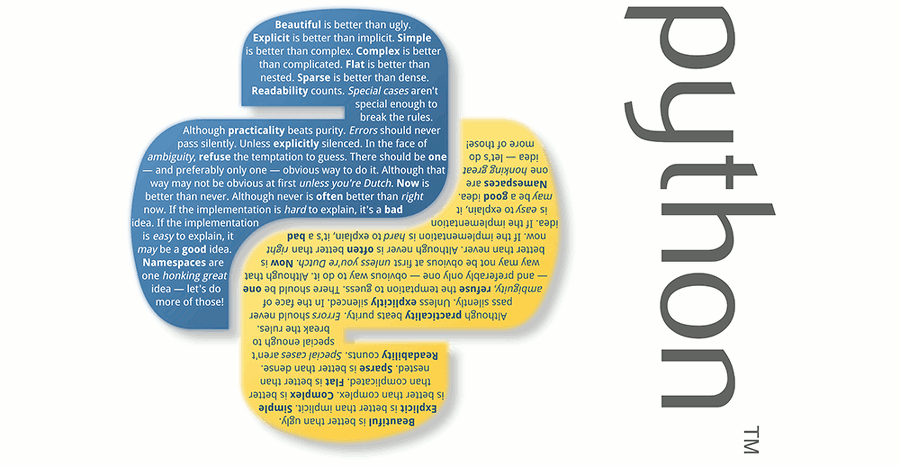
Python emerged as a leader among well-established and optimized languages including C, C++, and Java for very simple reasons. Python incorporates the principles of the philosophy that complex tasks can be done in simple ways. We tend to think that real-world, complex problems need complex pathways to produce complex solutions. The developers of Python embraced the exact opposite philosophy. Python was created to have an extremely fast and simple learning curve and development process for software engineers. As a result, it is considered the most general-purpose programming language since users can work in almost any study domain and still be able to find a useful piece of code for themselves. Python harnessed the power of the open source movement, which helped it amass a huge user base from virtually all walks of life. Being open source in nature, Python allowed people to make small programs and share them with each other with ease. In Python, a group of programs for performing various tasks makes up a module (package). At the time of writing, there are over 117,181 modules that have been submitted by an even larger number of developers around the world. The large number of modules and developers has allowed Python’s use to jump rapidly within the computer science community and finally grab the number-one position as the most favored programming language.